

02 March 2026
MTN acquires IHS – is this a shift in the tower ownership model?
Fourteen years after first selling its mobile towers to IHS, helping establish one of the largest independent multinational TowerCos in the world, MTN has now moved to acquire full control of the company (in which it already holds a 25% stake), at a valuation of USD6.2bn.
This represents a notable shift from the dominant trend of the last decade, which saw the rise of the TowerCo model, with many mobile operators deciding to divest their passive infrastructure. Against this backdrop, this article explores the main drivers of this transaction, and whether it signals a broader shift in the tower ownership model.
History of MTN and IHS
The relationship between the two companies began in 2012, when MTN sold 1800 towers in Côte d’Ivoire and Cameroon for USD284m, alongside a 10-year sale-and-leaseback agreement. This was followed in 2014 by the sale of a further 1300 towers in Zambia and Rwanda for USD105m.
MTN and IHS then established a joint venture in Nigeria, with MTN transferring around 9100 towers (valued at USD984m), while IHS assumed full operational control. In 2017, MTN exited the joint venture in exchange for additional equity in IHS, becoming its largest shareholder with a ~25% stake. This was followed by a further sale of ~5700 sites to IHS in 2021 for USD413m.
However, the relationship has not always been friendly. In 2024, amid a board-level dispute, MTN declined to renew approximately 2500 expiring leases in Nigeria. Following negotiations, these leases were ultimately split between IHS and American Tower, with the latter securing around 2100 new leases.
Broader TowerCo deal trends
MTN’s acquisition also reflects a broader shift in market conditions. Over the past decade, tower assets have attracted increasingly high valuation multiples, supported by low interest rates and strong investor appetite for stable, infrastructure-like cash flows. EV/EBITDA multiples for tower transactions rose from the mid-teens to a high of 30x for Telefonica’s sale of Telxius in 2021.
However, this trend has reversed with the return of higher interest rates and a tighter financing environment. TowerCos have increasingly shifted focus from expansion to profitability – as illustrated by, for example, Cellnex’s move away from aggressive M&A towards portfolio optimisation. As a result, valuation multiples have steadily declined over the last half decade, with MTN’s acquisition of IHS – at an implied ~8x EV/EBITDA1 – sitting at the lower end of recent transactions.
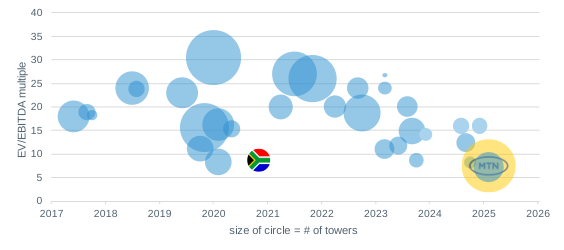
Global tower deal multiples are trending downwards
Unique factors for IHS
However, the IHS-MTN deal is not a simple extension of broader trends. Several unique factors have driven MTN’s acquisition, starting with the dramatic devaluation of the Nigerian Naira.
Nigeria represents a very important market for both MTN and IHS. It is by far the biggest market for IHS (around 60% of its revenues) and the second biggest market for MTN, after South Africa.
Despite a fast-growing population, Nigeria has faced major economic headwinds over the last five years. Throughout 2023 and 2024, the Nigerian Naira has devalued significantly, as a result of Nigeria’s government attempts to unify the official and unofficial exchange rates, control inflation, and reduce subsidy costs. This heavily affected both businesses.
For MTN, the devaluation resulted in a sharp reduction in reported service revenues in USD terms (~60% decline between 2022 and 2024). For IHS, while a significant portion of revenues is denominated in naira, the company has managed to implement some contractual protections to mitigate the impact of its devaluation – in particular, FX resets (tying the lease fee to hard currencies) and CPI-linked escalators (with inflation reaching ~33% in 2024) are applied to at least some of its leases in Nigeria. As a result, its revenue in Nigeria (much of which is from MTN) declined only by ~26%.
This creates a structural imbalance: MTN’s revenues are largely denominated in local currency, while a meaningful share of its costs – through tower leases – are indexed to hard currency. In periods of devaluation, this resulted in a transfer of value to IHS.
In this context, MTN is a natural buyer of IHS’ assets. Greater ownership of tower infrastructure provides improved control over cost dynamics, particularly in an environment of continued FX uncertainty.2
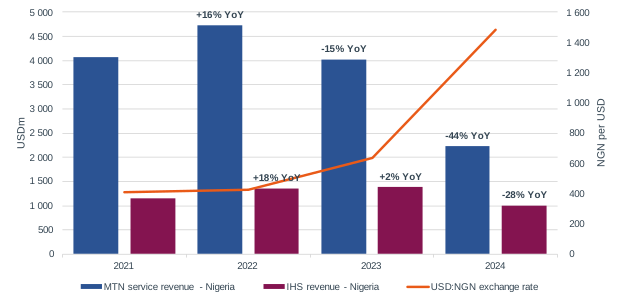
MTN more exposed to the Naira devaluation, while IHS benefits from some contractual protection
Limited growth upside makes integration into MTN more compelling
In addition to the macroeconomic dynamics, there is one key company-specific factor that has facilitated the transaction.
IHS has faced challenges in diversifying its revenue base. MTN continues to account for a significant majority of its African revenues (~70%). Tenancy ratio – a key performance indicator for an independent towerco and a driver of higher valuations – has been more limited than expected. In Nigeria, 9mobile’s exit from 2500 towers in 2025 pushed down the tenancy ratios down to the same level as in 2019:
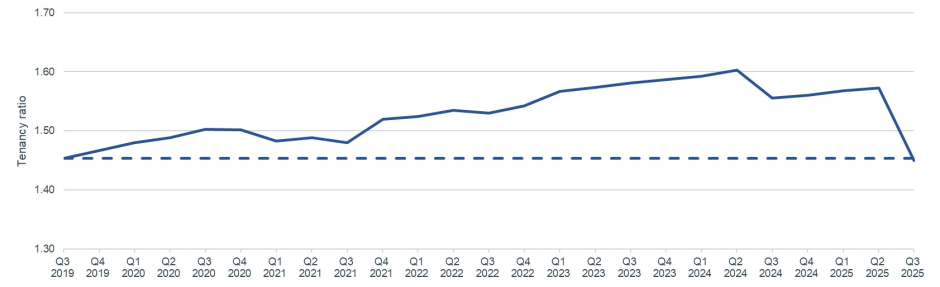
IHS’ tenancy ratio in its biggest market is at the same level as 2019
It is also difficult to see where the growth might come from, with ATC supplying towers to Airtel, and Glo still owning its own towers. More broadly, across all of IHS’ markets, the tenancy ratio has declined from 1.54x in 2020 to 1.48x in 2025.
This reduces IHS’s ability to deliver the tenancy-driven upside typically associated with the towerco model, lowering its standalone growth profile and making integration into MTN both strategically and operationally more straightforward.
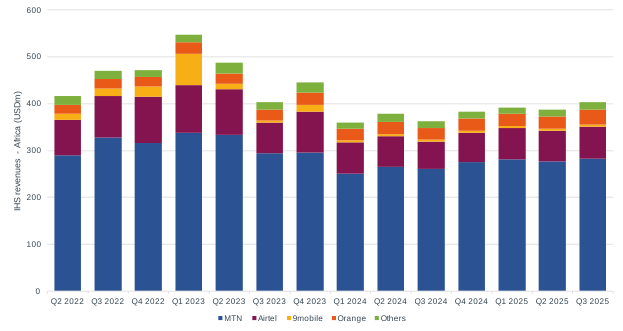
MTN accounted for 68% of IHS’s African revenues (2021–2025)
Takeways for tower owners and MNOs
MTN’s acquisition of IHS does not signal a reversal of the towerco model but highlights that tower ownership is a strategic lever, particularly in high-volatility markets.
For mobile operators, the transaction underlines the advantages of ownership, including greater control over costs and risks, as well as increased optionality for M&A and network sharing opportunities (we have previously written an article for TMT Finance about this).
For the tower owners, it reinforces that, beyond macro pressures (notably interest rates), structural risks are increasing – including stronger anchor-tenant bargaining power as initial SLB terms expire, and growing pressure from MNO consolidation reducing the number of possible tenants in a market.
Footnotes
1 Valuation at USD6.2bn, with an estimated EBITDA at USD820m (USD1000m EBITDA guidance for 2025 with a USD150m adjustment for the LATAM business disposal and a USD30m adjustment for the Rwandan business disposal)
2 While the exchange rate has stabilised following a series of loans from the World Bank, Nigeria’s exports are heavily reliant on oil, which is reported to account for over 90% of its foreign exchange earnings


