

27 March 2026
AI and the New Uplink Challenge: How Mobile Traffic Patterns Are Shifting
As AI‑based applications move into mainstream use, their influence on mobile network traffic is becoming clearer. Early measurements indicate that AI is not simply adding to existing volumes but has the potential to change the composition of mobile traffic, particularly by increasing the relative importance of uplink demand.
With mobile operators and regulators reassessing mid‑band strategy for 5G and preparing for early 6G frameworks, AI‑driven usage introduces additional uncertainty. If AI adoption continues to expand and more applications rely on user‑generated inputs, the traditional downlink‑heavy traffic balance may shift. In that case, operators would need to reconsider how they dimension and manage their networks, and regulators would need to assess how evolving traffic patterns should inform future spectrum planning, TDD configurations and wider network design
AI’s emerging traffic footprint
Despite the attention AI receives, it still represents a small share of total mobile traffic. According to the June 2025 Ericsson Mobility Report, GenAI traffic accounts for 0.06% of overall mobile usage. However, its traffic characteristics differ significantly from conventional mobile applications.
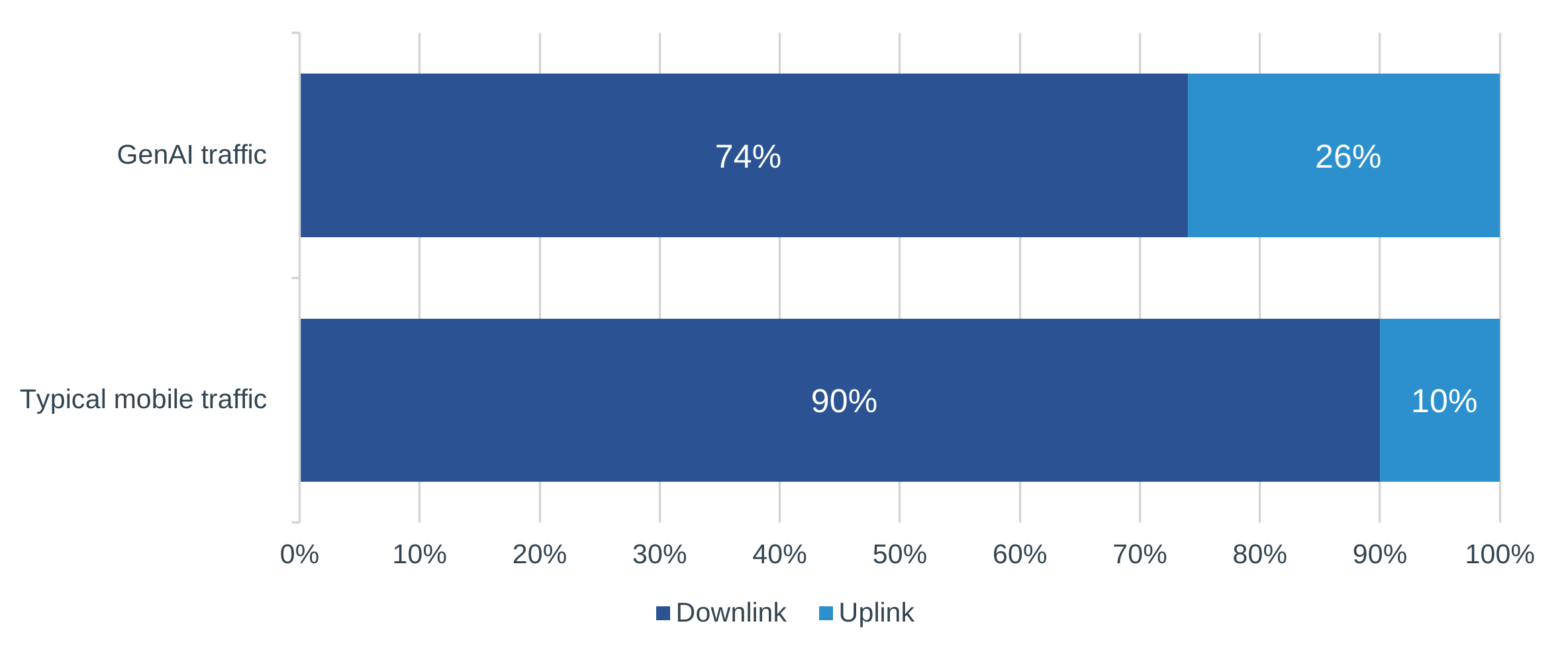
Where mobile networks typically exhibit a 90:10 downlink–uplink ratio, GenAI‑related usage already shows an average 26% uplink share1. This reflects the reliance of many AI tools on users uploading images, short audio clips and similar inputs required for inference.
The continued growth of AI services is further reshaping mobile traffic patterns. ChatGPT now sees approximately 5.35 billion monthly visits, up from 3.905 billion in February 2025. Around 27% of this traffic originates from mobile devices, highlighting the role of smartphones in day‑to‑day AI usage2.
What’s driving uplink growth?
AI’s influence on uplink traffic comes from several categories of applications, not only conversational tools:
Image and video‑based AI tools
Applications that create or process images and video generate far higher per‑user consumption than text‑based tools. Invideo AI users average 504MB per month, and many comparable visual GenAI apps exceed 200MB per user monthly. These functions involve uploading large media files or real‑time visual inputs, increasing uplink utilisation1.
Real‑time AI analysis
Devices that support real‑time AI interpretation – such as smart glasses and camera‑based assistants – rely on continuous upstream video rather than intermittent uploads. Even when compressed, continuous video requires materially higher uplink throughput and low‑latency performance. Because these streams remain active for extended periods, they create sustained uplink load that differs from traditional smartphone usage patterns.
On-device vs off-device processing
Where AI inference is performed has a direct impact on uplink demand. If computation happens on the device, most processing can be handled locally and uplink growth may remain limited. However, many AI functions are likely to rely on off‑device processing in edge or cloud environments, as this reduces device cost, lowers power consumption and allows support for larger or frequently updated models. When inference is carried out off‑device, applications still need to upload the inputs required for analysis – such as short video segments, images, audio samples or sensor data – which can increase uplink traffic as these uploads become more frequent. In many cases, both on‑device and off‑device processing may also enable new features that further increase uplink demand.
Implications for networks, spectrum and planning
The shift toward more uplink‑intensive usage raises several strategic questions:
1. Should TDD configurations allocate more uplink resources?
Current 5G mid‑band TDD configurations maintain a strong downlink bias, reflecting legacy usage dominated by video streaming and browsing. AI workloads generate more frequent, and in some cases continuous, uplink traffic. If these patterns grow, operators may need to adjust TDD slot ratios to provide additional uplink capacity, particularly in dense environments where device numbers and AI activity are highest. Even modest uplink increases could improve performance for AI‑driven applications.
In parallel, new techniques such as sub‑band full duplex (SBFD) are being explored within 3GPP as a way to increase uplink opportunity without relying solely on time‑domain rebalancing. SBFD enables simultaneous uplink and downlink transmission on different sub‑bands within the same TDD carrier, offering a potential method to relieve uplink constraints in downlink‑heavy mid‑band spectrum. While still at an early stage, these developments illustrate growing interest in more flexible duplexing schemes where uplink demand increases.
2. How should spectrum policy adapt?
Debates concerning the 3.5GHz and 6GHz bands have largely focused on increasing downlink capacity. The emergence of more uplink‑intensive AI usage challenges this assumption. Regulators will also need to consider how SDL bands, such as 1500MHz, fit into this shift: these bands were introduced specifically to strengthen downlink capacity and may be less aligned with a traffic profile where uplink demand grows more quickly.
As traffic patterns evolve, regulators will need to assess whether existing TDD allocations remain appropriate, recognising that operators cannot adjust uplink–downlink ratios independently. Any move toward more uplink‑supportive configurations would require coordinated changes across synchronisation regions. This raises questions about the feasibility and timing of regional updates to TDD frame structures, and how these would align with both SDL usage and cross‑border coordination requirements.
3. Can mobile networks absorb the shift?
As 5G adoption grows, any structural change in uplink traffic will affect network design. If AI drives uplink growth even moderately, operators will need to strengthen the RAN with more uplink‑boosting features, improved power‑control and scheduling, and potentially supplemental uplink layers in 6GHz or mmWave spectrum. Uplink planning, historically a secondary concern, will increasingly need to be treated as a primary design constraint.
Conclusion
AI remains at an early stage in its impact on mobile network traffic, but its effects are increasingly measurable and structurally different from previous technology cycles. While overall traffic volumes continue to rise, the most significant change is the emerging structural shift in uplink demand, driven by real‑time processing, multimodal inputs and increasingly capable AI services.
As AI‑enabled devices and applications become more widespread, uplink will no longer be a secondary consideration. For operators, regulators and industry stakeholders, understanding and preparing for this shift will be essential to sustaining network performance and enabling the next generation of AI‑based mobile services.
[1] Ericsson Mobility Report, ‘GenAI’s impact on network data traffic today’, June 2025
[2] Demandsage, ‘ChatGPT Statistics (2026) – Active Users & Growth Data’, 25 March 2026

